
Astronomers Catch Unprecedented Features at Brink of Active Black Hole
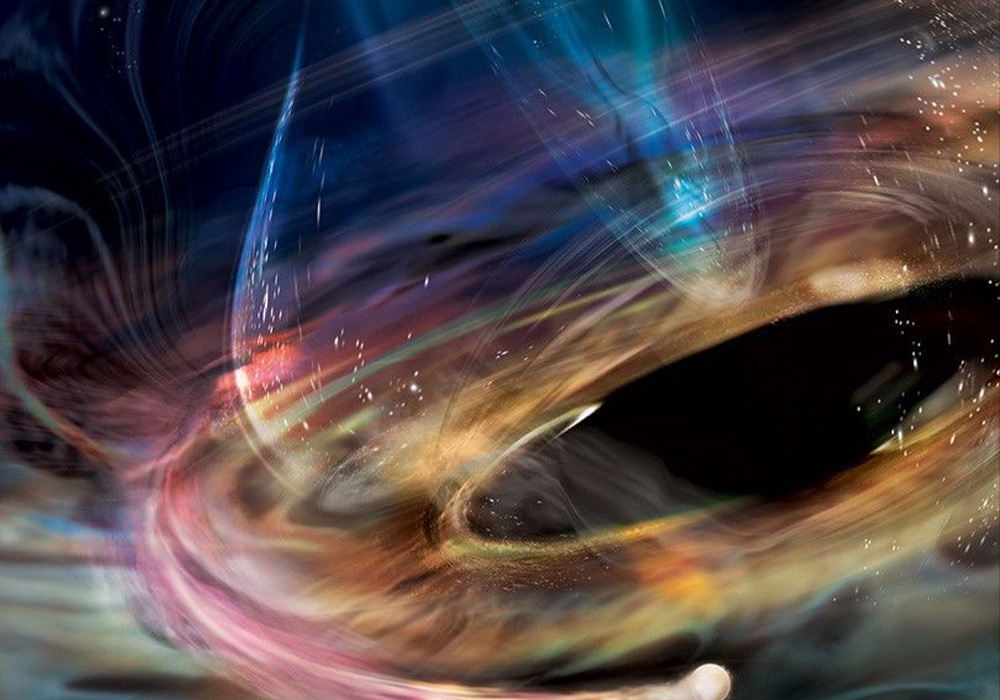
International teams of astronomers monitoring a supermassive black hole in the heart of a distant galaxy have detected features never seen before using data from NASA missions and other facilities. The features include the launch of a plasma jet moving at nearly one-third the speed of light and unusual, rapid X-ray fluctuations likely arising from near the very edge of the black hole.
The source is 1ES 1927+654, a galaxy located about 270 million light-years away in the constellation Draco. It harbors a central black hole with a mass equivalent to about 1.4 million Suns.
"In 2018, the black hole began changing its properties right before our eyes, with a major optical, ultraviolet, and X-ray outburst," said Eileen Meyer, an associate professor at UMBC. "Many teams have been keeping a close eye on it ever since."
After the outburst, the black hole appeared to return to a quiet state, with a lull in activity for nearly a year. But by April 2023, a team led by Sibasish Laha at UMBC and NASA's Goddard Space Flight Center had noted a steady, months-long increase in low-energy X-rays.
Radio data from February, April, and May 2024 reveals what appear to be jets of ionized gas, or plasma, extending from either side of the black hole, with a total size of about half a light-year. Astronomers have long puzzled over why only a fraction of monster black holes produce powerful plasma jets, and these observations may provide critical clues.
"The launch of a black hole jet has never been observed before in real time," Meyer noted. "We think the outflow began earlier, when the X-rays increased prior to the radio flare, and the jet was screened from our view by hot gas until it broke out early last year."
Using XMM-Newton observations, Masterson found that the black hole exhibited extremely rapid X-ray variations between July 2022 and March 2024. Over two years, the fluctuation period dropped from 18 minutes to just 7 — the first-ever measurement of its kind around a supermassive black hole.
The team found that a low-mass white dwarf — a stellar remnant about as large as Earth — could remain intact close to the black hole's event horizon while shedding some of its matter. If the black hole does have a white dwarf companion, the gravitational waves it produces will be detectable by LISA (Laser Interferometer Space Antenna).
Source: NASA, By Francis Reddy